
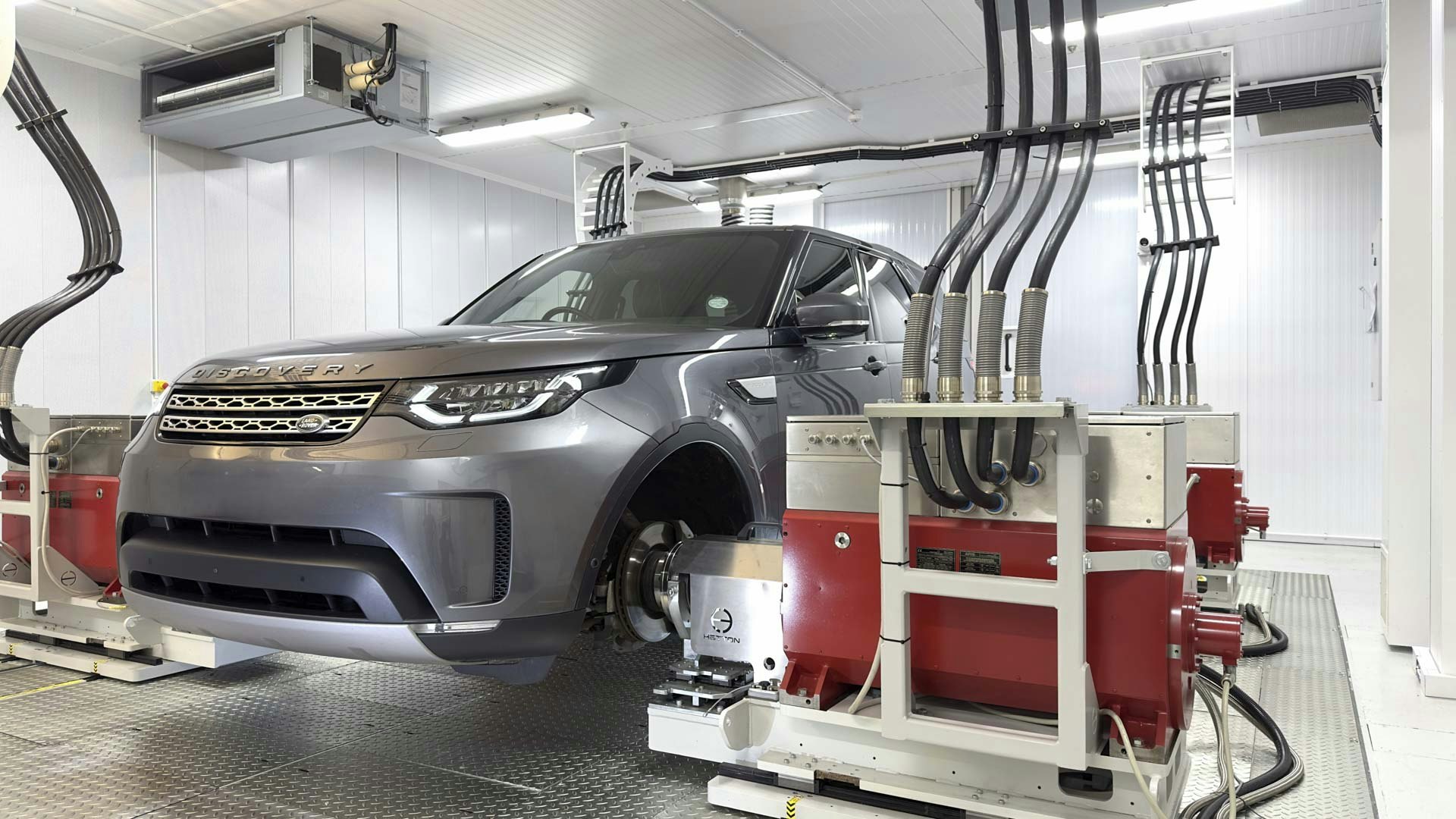
Cambustion accelerates new vehicle development with Powertrain in the Loop Testing
Cambustion has unveiled a new Powertrain in the Loop (PiL) testing platform featuring world-class hardware evaluation and simulation capability at our Hub Dyno facility in Cambridge.
As an independent testing specialist for almost 40 years, Cambustion has recently launched its PiL capability to automotive OEMs following the completion of a dedicated 12-month test programme that used the platform to support the development of a hybrid electric supercar.
PiL technology enables manufacturers to integrate, develop and validate vehicle systems before a physical vehicle is available. Vehicle-level testing can begin before the chassis and many supporting subsystems are available, allowing development activities to run in parallel and significantly reducing programme risk.
Manufacturers using the platform can combine real hardware with simulated vehicle subsystems using Cambustion's Hardware-in-the-Loop (HiL) capability. Systems that are not yet available in physical form can be represented in real time, allowing engineers to validate functionality, investigate interactions between systems and continue vehicle-level development without waiting for all hardware to be available.


Our Powertrain in the Loop system provides an efficient way to accelerate vehicle development within compressed timelines. The technology allows us to understand how each vehicle system will perform and interact before vehicle build and gives manufacturers confidence that systems and sub-systems will integrate and perform as intended.
The facility combines advanced vehicle simulation, Hardware in the Loop (HiL) capability and world-class measurement capability, allowing manufacturers to assess vehicle behaviour, develop control strategies and optimise system performance early in the development cycle. Customers of Cambustion’s EV powertrain group, CamMotive, can use the same PiL technology to assess and develop high-voltage systems including electric drive. In this case, a 1100 V / 500 kW battery simulator can be used where a physical battery is not available.
For powertrains already integrated into a vehicle chassis, testing can be performed by connecting directly to the wheel hubs. High-performance dynamometers accurately reproduce highly transient operating conditions, enabling assessment of everything from legislative drive cycles to advanced vehicle dynamics functions such as torque vectoring.
The temperature-controlled test cell supports testing across a wide range of environmental conditions, including temperatures down to -15°C, allowing manufacturers to assess vehicle performance, system robustness and control strategies under both representative and worst-case operating scenarios.
PiL enables vehicle attributes to be signed off, systems debugged and optimised, while vehicle build continues in parallel with confidence. Once a prototype vehicle becomes available, development can transition to our 4WD Chassis Dyno, or Hub Dyno PiL testing can continue alongside on-road and vehicle-based testing.
During our recent hybrid supercar programme, the Hub Dyno proved to be such a versatile and valuable development tool that the customer chose to continue PiL testing in parallel with prototype vehicle testing throughout the programme
Cambustion is an independent powertrain testing specialist working with Tier 1 suppliers, OEMs and research institutions to validate and optimise powertrain technologies for next-generation vehicles.
Engineering Projects @ CambustionSee some of the Cambustion Engineering Projects at the link above or get in touch to discuss your next project: https://www.cambustion.com/contact